DIY Smart Sprinkler System: Automate Watering & Save 30%
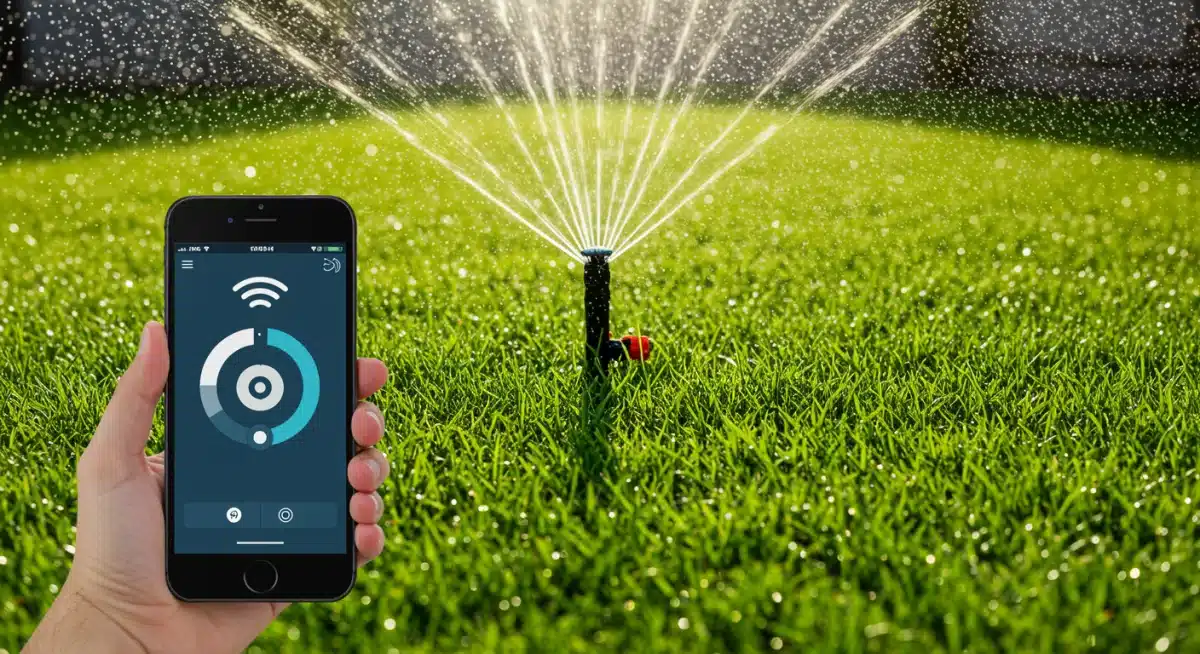
Are you looking to revolutionize your garden care, save money, and contribute to water conservation? A DIY smart sprinkler system offers an innovative solution, automating your watering schedule and potentially reducing your water usage by up to 30%.
Understanding smart irrigation: more than just a timer
Smart irrigation systems represent a significant leap forward from traditional sprinkler timers. While conventional timers operate on fixed schedules, smart systems leverage technology to optimize watering based on real-time conditions.
This intelligence is crucial for efficient water use, especially in areas prone to drought or with strict water conservation guidelines.
The core principle behind smart irrigation is to provide plants with exactly the right amount of water they need, precisely when they need it.
This eliminates overwatering, which can lead to plant disease and runoff, and prevents underwatering, which stresses plants and hinders growth. The result is healthier landscapes with less effort and significantly reduced water bills.
Key components of a smart system
A typical smart sprinkler system, whether DIY or professionally installed, relies on several interconnected components that work in harmony.
Understanding these parts is the first step toward building your own system.
Smart Controller: This is the brain of your system, connecting to your home Wi-Fi and allowing remote control via a smartphone app. It processes data from sensors and weather feeds.
Zone Valves: These electromechanical valves control water flow to different areas (zones) of your landscape, allowing for customized watering schedules for specific plant types or sun exposures.
Sensors: Various sensors provide critical data. Rain sensors prevent watering during or after rainfall, while soil moisture sensors measure the actual water content in the soil.
Weather Data Integration: Many smart controllers integrate with local weather forecasts, adjusting schedules based on predicted rain, temperature, and humidity.
By integrating these elements, a smart system can adapt to changing environmental conditions, ensuring your landscape thrives while minimizing water waste. This adaptability is what truly sets smart irrigation apart from its traditional counterparts.
Planning your DIY smart sprinkler system: design and components
Embarking on a DIY smart sprinkler system project requires careful planning. A well-thought-out design ensures optimal coverage, efficient water distribution, and compatibility with your existing landscape and water supply.
This initial phase is critical for the success and long-term performance of your system.
Start by sketching out your property, marking all areas that require irrigation. Consider different plant types—lawn areas, flower beds, vegetable gardens—as they often have varying water requirements.
Note down any existing sprinkler heads or pipes you might want to integrate or replace. This detailed map will serve as your blueprint.
Assessing your water supply and pressure
Before selecting components, it’s essential to understand your home’s water supply capabilities. This involves checking your water pressure (PSI) and flow rate (gallons per minute, GPM).
These measurements will dictate the number of sprinkler heads you can operate simultaneously and help you choose appropriately sized pipes and valves.
Measure static water pressure: Use a pressure gauge attached to an outdoor spigot.
Determine flow rate: Use a 5-gallon bucket and a stopwatch to measure how long it takes to fill the bucket. Divide 300 by the seconds taken to get GPM.
These figures are crucial for designing zones that won’t overwhelm your water system, ensuring consistent pressure and even watering across your landscape. Overlooking this step can lead to weak spray patterns and inefficient irrigation.
Choosing your smart controller and sensors
The market offers a variety of smart irrigation controllers, ranging from basic Wi-Fi enabled devices to advanced systems with complex algorithms and extensive sensor compatibility.
Research different brands and models, considering features like app interface, weather intelligence, zone capacity, and integration with other smart home platforms.
For sensors, a rain sensor is almost a mandatory addition, preventing unnecessary watering after precipitation. Soil moisture sensors provide even greater precision by measuring the actual moisture content at the root level, allowing the system to water only when the soil truly dries out.
These sensors connect directly to your smart controller, providing real-time data for intelligent adjustments.
Careful planning and component selection lay the groundwork for an efficient and effective DIY smart sprinkler system. Taking the time to assess your needs and resources upfront will save you headaches and ensure a successful installation.
Installation steps: from trenching to connecting the smart controller
Once your planning is complete and components are gathered, the installation process begins. While it might seem daunting, breaking it down into manageable steps makes the project achievable for most DIY enthusiasts. Safety and precision are paramount throughout this stage.
The first physical step often involves trenching. This is where you’ll dig narrow trenches for your pipes, ensuring they are deep enough to avoid damage from foot traffic, lawnmowers, or freezing temperatures, depending on your climate.
Mark your trench lines clearly based on your design map.
Laying pipes and installing sprinkler heads
With trenches dug, you can begin laying your PVC or poly pipe. PVC is rigid and requires solvent cement for connections, while poly pipe is flexible and uses barbed fittings with clamps.
Choose the type that best suits your comfort level and local conditions. Install your zone valves at strategic points, usually near the main water supply, ensuring easy access for future maintenance.
Connect pipes: Use appropriate fittings (elbows, tees, couplings) to create your desired layout. Ensure all connections are watertight.
Install sprinkler heads: Attach sprinkler heads to risers that extend from the main lateral lines. Position them according to your design to ensure overlapping coverage and avoid dry spots.
Flush the system: Before installing all sprinkler heads, flush the system to clear any debris that may have entered the pipes during installation.
Proper pipe sizing and head selection are crucial for even water distribution. Different heads have different spray patterns and ranges, so mix and match as needed for optimal coverage in each zone.
Wiring and connecting the smart controller
This is where your system truly becomes ‘smart.’ The zone valves need to be wired to your smart controller.
Most controllers have clearly labeled terminals for each zone and a common wire. Follow the manufacturer’s instructions carefully for correct wiring.
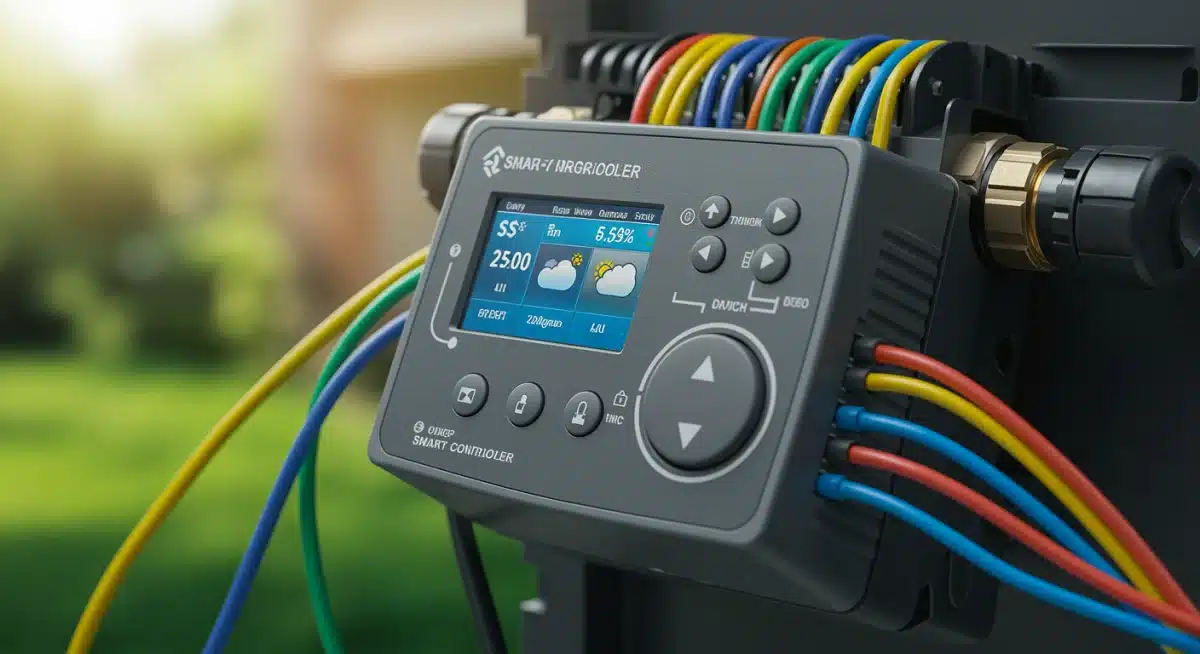
Once the wiring is complete, mount your smart controller in a sheltered location, usually in a garage or utility room, and connect it to your home Wi-Fi network. This allows it to access weather data and be controlled remotely via its dedicated smartphone app.
Test each zone manually using the controller’s interface to ensure all valves open and close correctly and that sprinkler heads are functioning as intended. This step verifies the physical integrity and basic functionality of your newly installed system.
Programming your smart system for optimal water savings
Installing the hardware is only half the battle; the true magic of a smart sprinkler system lies in its intelligent programming.
This phase is where you configure your system to maximize water efficiency, save money, and keep your landscape vibrant without constant manual intervention.
Most smart controllers offer user-friendly apps that guide you through the setup process.
You’ll typically input details about your landscape, such as soil type, plant type (lawn, shrubs, flowers), sun exposure, and sprinkler head type for each zone. These parameters are essential for the controller’s algorithms to calculate optimal watering schedules.
Leveraging weather intelligence and local data
A key feature of smart irrigation is its ability to adapt to real-time and forecasted weather. The controller connects to local weather stations or uses hyperlocal weather data to make informed decisions.
This means if rain is predicted, your system will automatically skip or delay watering cycles.
Rain skip: Automatically pauses watering if significant rainfall is detected or predicted.
Evapotranspiration (ET) adjustment: Adjusts watering duration based on how much moisture evaporates from the soil and transpires from plants, factoring in temperature, humidity, and wind.
Seasonal adjustment: Automatically increases or decreases watering times throughout the year to match seasonal changes in plant water needs.
By actively using this weather data, your system prevents unnecessary watering, which is a major source of water waste.
It ensures your plants receive water only when they truly need it, aligning with principles of xeriscaping and sustainable landscaping.
Implementing advanced features like soil moisture sensors
For even greater precision, integrating additional sensors, such as soil moisture sensors, takes your system’s intelligence to the next level.
These sensors are placed directly in the soil and communicate real-time moisture levels to your controller.
With soil moisture sensors, your system doesn’t just rely on weather predictions; it knows the actual water content in your soil. If the soil is already moist enough, the system will override scheduled watering, even if no rain is forecast.
This hyper-local data feedback loop ensures that every drop of water is applied with purpose, preventing both overwatering and underwatering, and truly optimizing your water usage for maximum savings and plant health.
Maintenance and troubleshooting your DIY smart system
Even the most advanced DIY smart sprinkler system requires periodic maintenance to ensure its longevity and continued efficiency. Regular checks can prevent minor issues from escalating into costly repairs and guarantee your system is always performing at its best, maximizing those water savings.
Start with a seasonal check-up. In spring, before heavy watering begins, inspect all sprinkler heads for damage, blockages, or misalignments.
Clean any clogged nozzles and adjust spray patterns to ensure water is directed only to your landscape and not onto sidewalks or driveways. Check for leaks in pipes and fittings, as even small leaks can waste significant amounts of water over time.
Common troubleshooting tips
Despite careful installation and programming, issues can arise. Knowing how to troubleshoot common problems can save you time and money on professional service calls. Many issues can be resolved with simple checks.
No water in a zone: Check the zone valve for power and proper wiring. Ensure the main water supply is on. Verify that the sprinkler head isn’t clogged or broken.
Uneven watering: Adjust sprinkler head nozzles and ensure proper pressure. Consider adding or repositioning heads for better coverage.
System not responding: Check your Wi-Fi connection. Restart the smart controller. Ensure the app is updated to the latest version.
Watering when it rains: Verify your rain sensor is clean and properly connected. Check its settings in the smart controller app.
Many smart controllers also have diagnostic features within their apps that can help pinpoint problems, offering error codes or status updates that guide you toward a solution.
Always consult your controller’s manual for specific troubleshooting steps.
Protecting your system from seasonal changes
In colder climates, winterizing your smart sprinkler system is essential to prevent freeze damage. This typically involves shutting off the main water supply to the system and using an air compressor to blow out all the water from the pipes and sprinkler heads.
Failing to winterize can lead to burst pipes and damaged components, requiring extensive repairs.
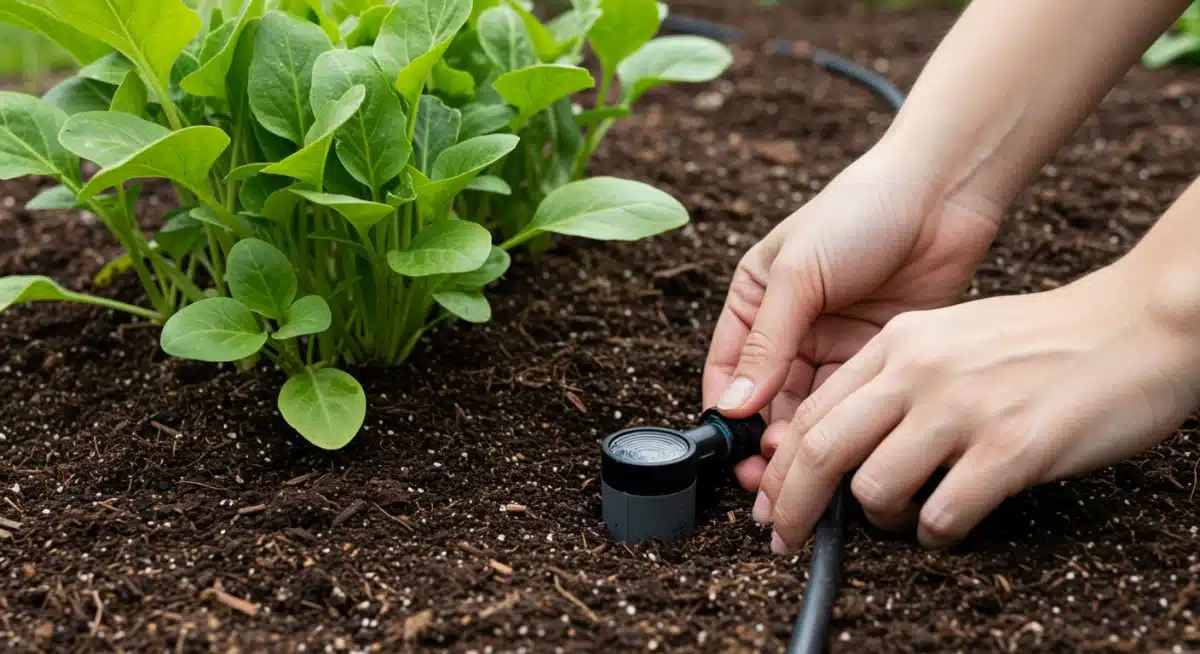
Conversely, in warmer regions, ensure your system is prepared for peak summer heat by verifying that seasonal adjustments are enabled and that your soil moisture sensors are accurately reporting.
Regular maintenance and proactive troubleshooting will keep your DIY smart sprinkler system running smoothly, saving water and money for years to come.
Advanced features and future-proofing your smart irrigation
The world of smart home technology is constantly evolving, and smart irrigation systems are no exception.
Beyond basic automation, many controllers offer advanced features that can further enhance efficiency, convenience, and integrate with your broader smart home ecosystem. Exploring these options can future-proof your investment and maximize its benefits.
One increasingly popular feature is hyper-local weather integration, which goes beyond standard regional forecasts.
Some systems can tap into localized weather data down to your specific street address, providing incredibly accurate predictions for rainfall, wind, and temperature. This precision allows for even finer adjustments to watering schedules, ensuring optimal water use.
Integrating with smart home platforms
Modern smart sprinkler controllers often offer compatibility with popular smart home platforms like Amazon Alexa, Google Assistant, or Apple HomeKit.
This integration allows you to control your irrigation system using voice commands or incorporate it into broader home automation routines.
Voice control: “Alexa, water zone 1 for 10 minutes.”
Automated routines: Link watering schedules to other smart devices, such as smart lights or security systems.
Data sharing: Some systems can share data with other smart garden devices, creating a more holistic approach to yard care.
This level of integration provides unparalleled convenience and allows your irrigation system to become a seamless part of your connected home.
Imagine your sprinklers automatically turning off if your smart security camera detects motion in the yard, or pausing if your smart weather station detects unexpected rainfall.
Exploring flow sensors and drip irrigation integration
For ultimate water efficiency and leak detection, consider adding a flow sensor to your system. A flow sensor measures the actual volume of water being used, providing real-time data to your controller.
If an unusual flow rate is detected (e.g., much higher than normal), the system can alert you to a potential leak or broken pipe, preventing significant water loss and property damage.
Furthermore, many smart controllers can manage drip irrigation systems alongside traditional sprinklers. Drip irrigation is highly efficient for targeted watering of specific plants, beds, or containers.
Integrating it into your smart system allows for precise, automated control over these specialized zones, further reducing water consumption. As technology advances, expect even more sophisticated sensors and integration options to become available, making your DIY smart sprinkler system an increasingly intelligent and responsive part of your home.
The economic and environmental benefits of smart watering
Beyond the convenience, the decision to install a DIY smart sprinkler system is driven by significant economic and environmental advantages.
These benefits extend from tangible savings on utility bills to a reduced ecological footprint, making smart irrigation a responsible choice for homeowners.
Economically, the most immediate and impactful benefit is the reduction in water consumption. By watering only when necessary and adjusting for weather conditions, smart systems can cut water usage by 30% or more.
This translates directly into lower water bills, providing a return on investment over time. In many regions, water rates are increasing, making these savings even more substantial.
Long-term savings and property value
The initial investment in a DIY smart sprinkler system might seem considerable, but the long-term savings often outweigh the upfront costs.
Reduced water bills accumulate over years, and the enhanced health of your landscape can also prevent expenses related to plant replacement or disease treatment caused by improper watering.
Lower utility bills: Consistent savings on water, and sometimes electricity if using a pump.
Increased property value: A well-maintained, healthy landscape enhances curb appeal and property value.
Reduced landscape maintenance: Automated watering frees up time and effort typically spent on manual irrigation.
Moreover, some local utility companies or state programs offer rebates or incentives for homeowners who install smart irrigation systems, further offsetting the initial cost. Check with your local water provider to see if you qualify for any such programs.
Environmental impact and sustainability
From an environmental perspective, smart irrigation plays a crucial role in water conservation, a vital concern in many parts of the United States. By preventing overwatering and runoff, these systems reduce the strain on local water supplies and wastewater treatment facilities.
Reduced runoff also means less fertilizer and pesticide pollution entering storm drains and natural waterways, protecting aquatic ecosystems.
Furthermore, efficient water use supports biodiversity by creating healthier, more resilient landscapes that require fewer chemical interventions.
Adopting a smart sprinkler system is a tangible step towards a more sustainable home and community, demonstrating a commitment to responsible resource management. It’s an investment that benefits both your wallet and the planet.
Real-world impact: case studies and user experiences
The theoretical benefits of a DIY smart sprinkler system are compelling, but real-world results offer the most convincing evidence of its value.
Across the United States, homeowners who have embraced smart irrigation are reporting significant savings and improved landscape health, validating the technology’s effectiveness.
Consider the experience of a homeowner in Arizona, a state grappling with severe drought conditions. After installing a smart controller and soil moisture sensors, they reported a 40% reduction in their monthly water bill during peak irrigation seasons.
Their lawn, previously stressed by inconsistent watering, became noticeably greener and more resilient, thriving with less water than before.
Diverse applications and measurable savings
The impact isn’t limited to arid regions. A family in Florida, facing high humidity and frequent rain, found their smart system invaluable for preventing overwatering and fungal diseases.
Their controller’s rain skip feature and evapotranspiration adjustments meant their irrigation only ran when genuinely needed, leading to a 25% decrease in water consumption compared to their old fixed-schedule timer.
Residential success: Countless homeowners report healthier plants and significant water bill reductions.
Community adoption: Many municipalities encourage smart irrigation, offering rebates due to proven water savings.
Improved plant health: Precise watering reduces plant stress, leading to more vibrant and disease-resistant landscapes.
These examples highlight how smart systems adapt to diverse climates and plant needs, consistently delivering on their promise of efficiency. The technology empowers homeowners to take control of their water usage, making informed decisions rather than relying on guesswork.
User testimonials and satisfaction
User testimonials frequently emphasize not only the financial savings but also the convenience and peace of mind that come with smart irrigation. Homeowners appreciate the ability to manage their system remotely, adjust schedules on the fly, and receive alerts about potential issues.
The data provided by smart controllers, such as water usage reports and savings estimates, further reinforces user satisfaction. These insights help homeowners understand their consumption patterns and make further optimizations.
The positive experiences shared by these users underscore the practical, tangible benefits of making the switch to a smart sprinkler system, proving that this DIY project is a worthwhile endeavor for anyone looking to automate watering, conserve resources, and save money.
| Key Aspect | Brief Description |
|---|---|
| Water Savings Potential | Automated, weather-aware watering can reduce consumption by 30% or more. |
| Smart Controller | The central hub, connecting to Wi-Fi for remote control and data processing. |
| Sensor Integration | Rain and soil moisture sensors provide real-time data for precise watering. |
| Environmental Impact | Reduces water waste, runoff, and chemical pollution, promoting sustainability. |
Frequently asked questions about DIY smart sprinkler systems
A DIY smart sprinkler system can typically save 30% or more on water usage. This is achieved by optimizing watering schedules based on real-time weather data, plant needs, and soil moisture levels, preventing unnecessary watering and runoff.
While it requires some basic plumbing and electrical knowledge, many smart systems are designed with DIYers in mind. With careful planning, the right tools, and step-by-step instructions, it’s a manageable project for most homeowners.
Key components include a smart irrigation controller, suitable zone valves, and at least a rain sensor. Soil moisture sensors and proper piping (PVC or poly) and sprinkler heads are also crucial for optimal performance.
Yes, many smart sprinkler controllers offer compatibility with popular smart home platforms like Amazon Alexa, Google Assistant, or Apple HomeKit. This allows for voice control and integration into broader home automation routines for enhanced convenience.
Regular maintenance includes seasonal checks for leaks, cleaning sprinkler heads, and adjusting spray patterns. Winterizing the system by blowing out water from pipes is essential in colder climates to prevent freeze damage.
Conclusion
Embracing a DIY smart sprinkler system is a powerful step towards a more sustainable and efficient home. By automating your irrigation with intelligent technology, you not only ensure your landscape receives optimal care but also make a tangible impact on water conservation and your utility bills.
The journey from planning to programming offers both a rewarding project and lasting benefits for your wallet and the environment, proving that smart choices can lead to greener outcomes in more ways than one.